
Sarkaru Vaari Paata iBOMMA is one of those star-driven commercial entertainers that arrives with all the familiar promises of glamour, swagger, punchy dialogue, emotional payoff, and a hero larger than the world around him. Directed as a glossy mainstream Telugu film with a clear understanding of fan expectations, Sarkaru Vaari Paata aims to blend financial crime, romance, family sentiment, and mass action into a single cinematic package. What makes the film interesting is not merely its star power, but the way it tries to connect a socially relevant issue—money, debt, and exploitation—with the kind of exaggerated heroism that defines big-screen Telugu entertainment. For viewers searching for Sarkaru Vaari Paata iBOMMA content, the film offers plenty to discuss, from Mahesh Babu’s effortless screen presence to its uneven yet entertaining mix of style, emotion, and commercial spectacle.
| Movie | Sarkaru Vaari Paata |
| Language | Telugu |
| Screen | Theatrical / Digital Presentation |
| Release Date | 2022 |
| Star Cast | Mahesh Babu, Keerthy Suresh, Samuthirakani, Nadhiya, Subbaraju |
| Genres | Action, Drama, Romance, Commercial Entertainer |
| Director | Parasuram |
| Writer | Parasuram |
| Producer | Mythri Movie Makers, G. Mahesh Babu Entertainment, 14 Reels Plus |
| Music | S. Thaman |
| Cinematographer | R. Madhi |
| Editor | Marthand K. Venkatesh |
| Country | India |
Plot
Sarkaru Vaari Paata follows Mahesh, a confident and sharp-witted money lender who lives by a simple principle: debt is never just about money, it is about dignity, power, and consequence. Set initially against an urban, international backdrop before moving into more emotionally charged domestic terrain, the film builds its narrative around financial wrongdoing and personal loss. Mahesh is not introduced as a tragic hero in the conventional sense; instead, he enters the story with swagger, style, and a razor-edged understanding of human weakness. That makes his gradual emotional unveiling more effective, because the film allows the audience to first enjoy his attitude before exposing the scars beneath it.
The central conflict begins to take shape when he crosses paths with a woman whose charm, unpredictability, and impulsiveness pull him into an increasingly tangled situation. What appears at first to be a playful romantic track slowly opens the door to a larger story involving manipulation, privilege, institutional power, and unresolved pain. The screenplay clearly wants to package this journey as a mainstream entertainer, so it never abandons humor, confrontational dialogue, or hero elevation. Yet beneath the surface, the plot also gestures toward a critique of how systems of debt can humiliate ordinary people while protecting those with influence.
What works in the film’s favor is its ability to maintain curiosity even when the broad structure feels familiar. The issue is not whether the audience can guess where the story is heading, but whether the film can keep the journey engaging. For long stretches, it succeeds through mood, charisma, and confrontation. The dramatic material is rooted in injury—both financial and emotional—and this gives the film a stronger foundation than a routine commercial action drama. At the same time, the narrative is not always disciplined. It occasionally stretches scenes for fan service or tonal indulgence, but it rarely loses its underlying intention. For viewers exploring iBOMMA movie reviews, this is the sort of film that thrives less on twists and more on the impact of how each familiar beat is staged and delivered.
Performance
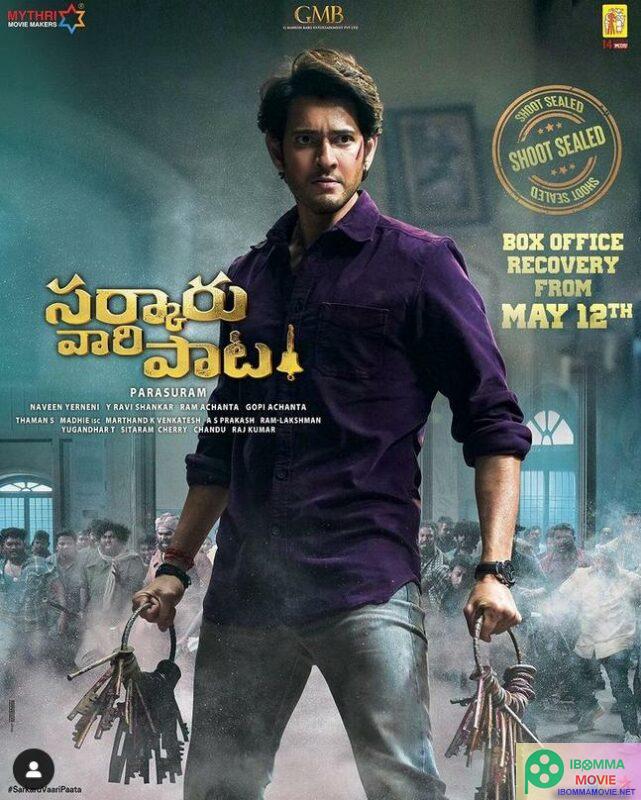
Mahesh Babu is unquestionably the film’s biggest strength. He carries Sarkaru Vaari Paata with a performance that feels relaxed, assured, and highly aware of his star image. What stands out here is not simply his ability to dominate a frame, but the playful confidence with which he moves through the film’s shifts in tone. In the lighter portions, he is effortlessly amusing, especially in scenes that rely on sarcasm, teasing, or stylized flirtation. In the more dramatic sections, he reveals enough restraint to prevent the character from becoming a cardboard mass hero. He understands that the role requires coolness first and vulnerability later, and he calibrates that progression well.
Keerthy Suresh brings a deliberately energetic and somewhat eccentric quality to her character. Her performance is designed to be lively rather than subtle, and she commits fully to that approach. At times, the characterization feels exaggerated, but Keerthy’s screen confidence prevents it from collapsing into mere noise. She creates an unpredictable rhythm in the first half, and even when the writing pushes her toward broad commercial conventions, she maintains a certain spark that keeps the romantic track watchable. Her chemistry with Mahesh Babu is one of the film’s more commercially effective elements, especially when the screenplay gives them conversational tension rather than routine sweetness.
Samuthirakani, as expected, delivers authority with minimal fuss. He has the kind of presence that can suggest menace, arrogance, or political calculation without ever needing to overplay a scene. In a film where several moments are pitched loudly, his controlled performance helps ground the antagonist’s world. Nadhiya and the supporting cast contribute competently, though the script is more interested in function than layered characterization for them. Still, the ensemble fits the universe the film is trying to create. This is not an acting showcase in the art-house sense, but as a mainstream performance vehicle, it works because its lead actor knows exactly what emotional and tonal register the audience has come to see. That is a major reason why Sarkaru Vaari Paata remains engaging even when the writing takes detours.
Direction and Screenplay
Parasuram directs the film with a clear understanding of what the genre demands. He knows that a star-led Telugu commercial entertainer must deliver visual attitude, memorable hero moments, emotional revenge, and enough dramatic momentum to justify its excesses. In that respect, he succeeds often enough to make the film satisfying for its intended audience. He builds several scenes around confrontation, not action alone, and that is an intelligent choice. The hero’s power in this story is not merely physical; it is verbal, psychological, and symbolic. The direction recognizes that and stages multiple interactions as battles of pride and intimidation.
The screenplay, however, is a more uneven affair. Its strongest idea lies in connecting personal trauma with the politics of money and humiliation. Debt in this film is never treated as a dry financial concept. It becomes a social weapon, a source of shame, and a tool used differently by the powerless and the powerful. That thematic spine gives the story greater emotional weight. But the writing does not always trust that strength. It frequently leans into formula, stretching comedic stretches, repeating attitude-heavy beats, or delaying dramatic revelations in ways that slightly weaken narrative tension.
Even so, the film’s storytelling is not lazy. It is calculated in a commercial sense. Parasuram knows when to pause for applause-worthy heroism and when to reconnect the story to its emotional roots. The issue is balance. The first half is more flamboyant and playful, while the second half becomes more sentimental and issue-driven. That tonal transition is not always seamless, but it does give the film a larger emotional arc than a one-note mass entertainer. In visual terms, the film remains polished throughout. The framing often emphasizes hero mythology, but it also knows when to widen out and give the world a glossy, aspirational texture. For audiences who browse iBOMMA pages looking for stylish Telugu blockbusters, this film absolutely fits the mold, though it also attempts to carry a slightly more serious undercurrent beneath the fan-pleasing surface.
Music
S. Thaman’s music plays a vital role in shaping the film’s energy. In a commercial Telugu entertainer, songs and background score are not supplementary; they are structural. They establish star aura, energize transitions, heighten emotion, and sometimes even rescue scenes that would otherwise feel too familiar. Thaman understands this grammar thoroughly. The soundtrack in Sarkaru Vaari Paata is designed to be immediately catchy, but the more interesting contribution comes from the background score, which constantly works to enhance Mahesh Babu’s image and sustain the film’s swagger.
The songs arrive with visual polish and rhythmic accessibility, serving the film’s glamorous and crowd-pleasing side. They add bounce to the first half and create breathing room between heavier dramatic segments. Yet the score is arguably the more important component. In confrontation scenes, Thaman uses pulsating motifs and build-ups that sharpen the hero’s emotional and moral stance. In dramatic moments, the music shifts toward sentiment without becoming too soft, maintaining the film’s larger-than-life tone even when it touches on pain.
There are moments when the score feels intentionally loud, but that is almost part of the design. This is a film that wants the audience to feel impact before reflection. The music does not seek realism; it seeks amplification. And in that role, it is effective. Whether accompanying a witty exchange, a romantic beat, or a power-laden showdown, the soundtrack keeps the film from losing momentum. For a movie so dependent on aura and rhythm, that contribution is essential.
Theme
The most compelling aspect of Sarkaru Vaari Paata is the way it frames money not just as an economic necessity but as a moral battlefield. The film repeatedly returns to the idea that financial exploitation destroys more than bank balances; it strips people of respect, confidence, and agency. That gives the movie a thematic seriousness that distinguishes it from purely ornamental action dramas. The hero’s rage is not random. It comes from understanding how systems can be manipulated so that the vulnerable bear the consequences while the powerful remain protected.
At the same time, the film is very much a populist fantasy. It imagines a world where one charismatic figure can challenge entrenched corruption and restore a sense of justice through force of will, intelligence, and presence. That fantasy is part of its appeal. But underneath that mass-cinema construction is a real emotional current about accountability, memory, and the ways childhood wounds shape adult identity. The hero’s relationship to debt is deeply personal, and the film suggests that financial injustice can leave marks as painful as physical violence.
There is also an interesting contrast between appearance and truth. The film’s glamorous surfaces—luxury spaces, stylish costumes, polished set pieces—exist alongside a story about emotional deprivation and systemic cruelty. That tension gives the movie a dual character. It wants to entertain with spectacle, but it also wants to remind viewers that money can corrupt relationships, distort values, and redefine self-worth. It may not explore these ideas with complete subtlety, but it engages them with enough conviction to leave an impression. In that sense, the film offers more than just star moments for the iBOMMA audience; it provides a mainstream emotional argument about justice and dignity.
Conclusion
Sarkaru Vaari Paata is an engaging, polished, and intermittently powerful commercial entertainer that works best when it leans into its central emotional conflict rather than its more routine formula. Mahesh Babu’s star performance gives the film its spine, while Parasuram’s direction ensures that even familiar material has enough energy and visual confidence to remain watchable. The film is not flawless. Its tonal shifts can be uneven, some portions feel overstretched, and the screenplay occasionally chooses celebration over precision. But its combination of style, sentiment, and issue-based drama gives it a stronger identity than many standard star vehicles.
For viewers interested in Sarkaru Vaari Paata iBOMMA style reviews, this film stands as a solid example of contemporary Telugu commercial cinema that tries to be both entertaining and emotionally resonant. It delivers fan service, romance, drama, and confrontation with conviction, while also touching on themes of debt, exploitation, and personal justice. That balance may not always be perfect, but it is often compelling. In the end, Sarkaru Vaari Paata succeeds because it understands the emotional thrill of watching a hero who is not just fighting villains, but confronting a system that has turned money into a weapon. That idea gives the film its staying power long after the applause-heavy moments fade.