
Baahubali 2: The Conclusion is the kind of epic that arrives with enormous expectations and somehow still manages to surpass them. For audiences who followed the first film and waited for answers, this sequel delivers not only resolution but expansion, emotional depth, and cinematic force on a much grander scale. From the very first stretch of the film, Baahubali 2: The Conclusion iBOMMA positions itself as more than a continuation of a blockbuster phenomenon. It becomes a fully realized saga of power, sacrifice, betrayal, and legacy. In the world of large-scale Indian cinema, and even among films often discovered through platforms or search patterns related to iBOMMA, this sequel stands out as a rare event film that combines spectacle with storytelling maturity.
| Movie | Baahubali 2: The Conclusion |
| Language | Telugu |
| Screen | 2D / 3D / IMAX |
| Release Date | 2017 |
| Star Cast | Prabhas, Rana Daggubati, Anushka Shetty, Ramya Krishnan, Sathyaraj, Nassar, Tamannaah Bhatia |
| Genres | Epic Action, Drama, Fantasy |
| Director | S. S. Rajamouli |
| Writer | V. Vijayendra Prasad |
| Producer | Shobu Yarlagadda, Prasad Devineni |
| Music | M. M. Keeravani |
| Cinematographer | K. K. Senthil Kumar |
| Editor | Kotagiri Venkateswara Rao |
| Country | India |
Plot
Baahubali 2: The Conclusion picks up with the weight of a question that had already entered popular culture long before the film itself arrived. But instead of depending only on suspense, the sequel builds a far richer and more emotionally layered narrative around that central mystery. The film moves between past and present, revealing the rise of Amarendra Baahubali, the politics of Mahishmati, and the chain of decisions that transformed loyalty into betrayal. It is a structure that gives the story a grand mythological rhythm, yet the emotional core remains deeply human.
The plot follows Amarendra Baahubali at the height of his nobility and promise, showing how his courage, humility, and instinctive compassion make him beloved by the people. Unlike rulers who inherit authority and wield it as entitlement, Amarendra earns respect through action. This distinction becomes crucial as the story develops. What initially appears to be a royal succession conflict gradually unfolds into something more painful and personal: a tragedy born from jealousy, manipulation, wounded pride, and political scheming. As the narrative progresses, the film reveals how private insecurities and courtly ambition can corrupt even the most majestic of kingdoms.
One of the film’s greatest strengths is how it balances revelation with emotional investment. The screenplay does not merely answer what happened; it makes the audience feel why it mattered. Every major turn in the story is connected to character rather than existing as a mechanical twist. The conflict between Amarendra Baahubali and Bhallaladeva is not staged as a simple clash between hero and villain. It is framed as a struggle over the moral meaning of kingship, power, and legitimacy. By grounding the political conflict in emotional consequence, the film avoids feeling like a hollow spectacle.
The present-day portions involving Mahendra Baahubali also carry real momentum, because the audience now understands the depth of the injustice that must be confronted. The film’s plotting is expansive, but it never loses sight of its emotional destination. Without over-spoiling key beats, it is fair to say that Baahubali 2: The Conclusion iBOMMA succeeds because it provides both answers and catharsis. It offers an ending that feels earned, not rushed, and it turns a popular cliffhanger into a fully satisfying dramatic payoff. For viewers who encounter the film through epic-cinema discussions or iBOMMA-related searches, this is the rare sequel that truly justifies its own scale.
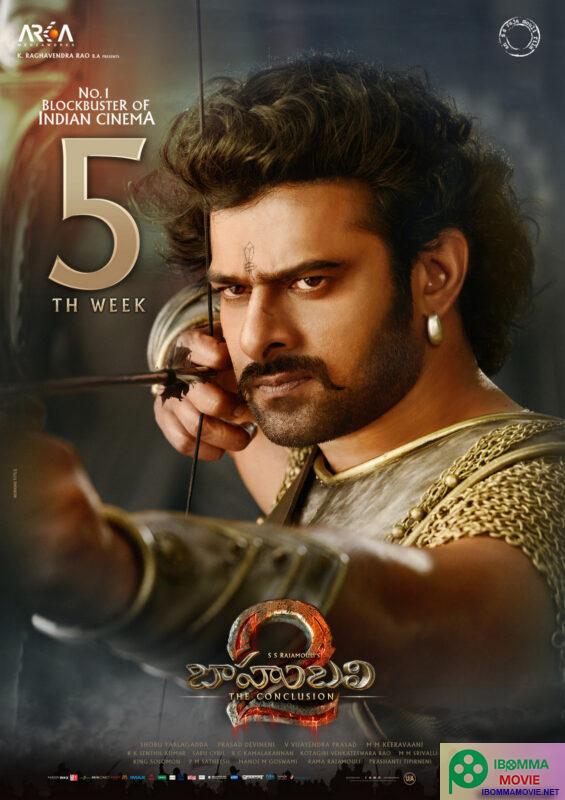
Performance
Prabhas delivers the defining performance of the film by creating a meaningful distinction between Amarendra Baahubali and Mahendra Baahubali. Though both characters share the same heroic aura, he gives each one a different emotional texture. As Amarendra, Prabhas is warm, composed, noble, and quietly charismatic. He projects a ruler’s grace without appearing distant from ordinary people. There is gentleness in his authority, which makes the character’s popularity believable. As Mahendra, he shifts into a more direct, energetic, and forceful mode. The duality never feels gimmicky. Instead, it becomes a central reason why the film works emotionally as well as visually.
Rana Daggubati gives Bhallaladeva a hard, cold intensity that makes him much more than a physically imposing antagonist. He brings arrogance, resentment, and predatory control into every scene. What makes Rana especially effective is that he never overplays the role into absurdity. He understands that true menace often comes from calculation rather than noise. Bhallaladeva is dangerous not merely because he is powerful, but because he believes power belongs to him by design. That entitlement sharpens every confrontation and makes the eventual emotional release of the film far more impactful.
Anushka Shetty is one of the film’s strongest emotional presences. As Devasena, she combines regal elegance with fierce inner strength. She does not play the role as a symbolic queen waiting to be rescued. Instead, she gives the character a moral backbone and emotional intelligence that reshape the film’s dramatic core. Her scenes carry dignity, pain, and resistance in equal measure. Devasena’s strength is not ornamental; it is foundational to the film’s emotional architecture, and Anushka performs that strength with commanding conviction.
Ramya Krishnan once again proves indispensable as Sivagami. Her performance is majestic but never static. She plays authority, love, pride, and tragic misjudgment with extraordinary control. The character is written with complexity, and Ramya brings out every dimension of that complexity without losing the royal intensity that defines her screen presence. Sathyaraj as Kattappa carries much of the film’s moral sorrow. His performance is rooted in loyalty, anguish, and internal conflict, which gives several crucial scenes their emotional weight. Nassar and Tamannaah Bhatia contribute effectively within the broader ensemble, helping the world feel interconnected and alive.
The performances in Baahubali 2: The Conclusion do something rare in spectacle-heavy cinema: they keep the emotional machinery working beneath the visual grandeur. That is why the film remains so powerful even beyond its action scenes. Whether discussed in mainstream criticism or discovered via terms like iBOMMA, the cast’s commitment is central to the film’s enduring impact.
Direction and Screenplay
S. S. Rajamouli directs this sequel with astonishing confidence. If the first film was about constructing myth, the second is about fulfilling it. Rajamouli understands that spectacle alone cannot carry a conclusion; a finale needs emotional precision, thematic weight, and narrative payoff. That is exactly what he provides. His direction here is more assured, more emotionally calibrated, and in many ways more disciplined than in the first film. The action is bigger, the visuals are grander, but the storytelling is also sharper.
The film’s screenplay, written by V. Vijayendra Prasad, is especially strong in its use of delayed revelation and dramatic irony. Since the audience enters the film already aware that betrayal has occurred, the narrative is not driven by simple surprise. Instead, it is driven by the painful inevitability of watching envy and manipulation distort relationships that might otherwise have flourished. This is a smart narrative choice. It transforms the film from a puzzle into a tragedy, and that change gives the story much more emotional resonance.
Rajamouli’s staging of court politics, battlefield strategy, and emotional confrontation is consistently impressive. He has a rare ability to frame characters in ways that communicate hierarchy, tension, and mythic stature all at once. Large crowd scenes never feel anonymous, and intimate dramatic scenes never feel dwarfed by the production’s scale. The kingdom of Mahishmati is presented not merely as a visual marvel, but as a functioning world shaped by ritual, ego, inheritance, and fear. That level of cinematic control is what separates Baahubali 2: The Conclusion iBOMMA from many other event films that look grand but feel emotionally hollow.
The pacing is also noteworthy. Despite the film’s long runtime and enormous narrative burden, it rarely feels stagnant. Rajamouli moves fluidly between romance, political drama, action, and emotional devastation. Even when the film leans into melodrama, it does so with conviction rather than hesitation. That confidence matters. This is a director who knows the tone he wants and commits to it fully. The result is a sequel that not only answers the questions raised by the first installment but elevates the entire saga into something much more memorable and complete.
Music
M. M. Keeravani’s music in Baahubali 2: The Conclusion is one of the film’s most powerful emotional instruments. In a story built on grandeur, honor, heartbreak, and revenge, the score plays a vital role in shaping how those emotions land. Keeravani does not treat music as background decoration. He uses it to deepen atmosphere, intensify character identity, and create a sense of ceremonial scale that matches the film’s mythic ambitions.
The background score is especially effective during moments of emotional transition. Scenes of triumph feel larger because of the music, but so do scenes of betrayal and grief. There is a stately quality to many of the orchestral passages, which suits the royal setting, yet Keeravani also knows when to shift into a more intimate emotional register. This flexibility allows the film to move between public spectacle and private anguish without feeling tonally fragmented.
The songs contribute meaningfully to the narrative world as well. Rather than interrupting the story, they often extend character emotion, romantic atmosphere, or royal grandeur. Some tracks bring tenderness, while others underline majesty or tension. What matters most is that the soundtrack feels unified. It belongs to this world completely. The melodies and arrangements reinforce the sense that the audience is entering not just a film, but a legend with its own emotional vocabulary.
By the time the climax arrives, the score becomes inseparable from the experience of catharsis. It amplifies not just action, but culmination. That is the true achievement of Keeravani’s work here. He composes music that does not merely accompany images; it helps transform them into memory. In a film of this scale, that kind of musical authorship is invaluable.
Theme
At its core, Baahubali 2: The Conclusion is about the moral burden of power. The film repeatedly asks what makes a leader worthy of devotion. Is it lineage, brute strength, military conquest, political strategy, or the ability to protect and uplift others? Amarendra Baahubali emerges as the answer to that question not because the script insists on his greatness, but because his actions reveal an ethic of leadership rooted in humility, courage, and empathy. The contrast with Bhallaladeva is not simply personal rivalry. It is a clash between two visions of authority.
The film also explores betrayal in a profoundly emotional way. Betrayal here is not only the act of one enemy destroying another. It is the consequence of envy entering family structures, institutions, and systems of trust. The tragedy of the story lies in how love and loyalty are weaponized by pride and manipulation. This gives the film a deeper emotional gravity than many large-scale fantasy dramas. The wounds are political, but they are also intensely personal.
Another major theme is legacy. The story insists that greatness cannot be erased permanently, even when it is suppressed by violence or rewritten by those in power. Memory survives through people, through resistance, and through the values passed from one generation to another. Mahendra’s arc in the present timeline is not only about vengeance. It is about reclaiming truth and restoring moral order to a kingdom built on distortion. That thematic layer gives the climax its satisfying sense of restoration.
The film’s emotional framework is also shaped by maternal power, dignity, and endurance. Characters like Sivagami and Devasena are not marginal supports to a male epic; they are decisive forces within it. Their choices, strengths, and failures shape the kingdom’s destiny. This adds dramatic richness to the film and gives it more emotional density than a simpler hero-versus-villain narrative might allow. That is one reason why Baahubali 2: The Conclusion, whether discussed in film circles or discovered through iBOMMA search traffic, continues to resonate as something more than a spectacle-heavy blockbuster.
Conclusion
Baahubali 2: The Conclusion is a rare sequel that does everything a grand finale is supposed to do. It answers long-awaited questions, expands the emotional world of the story, sharpens the thematic stakes, and delivers moments of visual and dramatic payoff that feel genuinely earned. Rather than collapsing under the weight of expectation, it transforms expectation into momentum. That alone makes it remarkable.
What ultimately elevates the film is its combination of scale and sincerity. Rajamouli stages battles, betrayals, and royal confrontations with operatic flair, but he never loses sight of why the audience should care. The characters matter, the emotions land, and the kingdom of Mahishmati feels like a living myth rather than a digital backdrop. The performances deepen the tragedy, the screenplay strengthens the suspense, and the music gives the film a majestic emotional pulse from beginning to end.
For viewers exploring epic Indian cinema, revisiting landmark Telugu blockbusters, or navigating film searches connected to iBOMMA, Baahubali 2: The Conclusion iBOMMA remains one of the most satisfying large-scale cinematic experiences of its generation. It is not just a sequel that completes a story. It is the moment where a successful franchise becomes a legend.